gottahunt.com/wingshooting/SNFQ0YrHBzFR/wingshooting-the-helmeted-guineafowl
Wingshooting the Helmeted Guineafowl
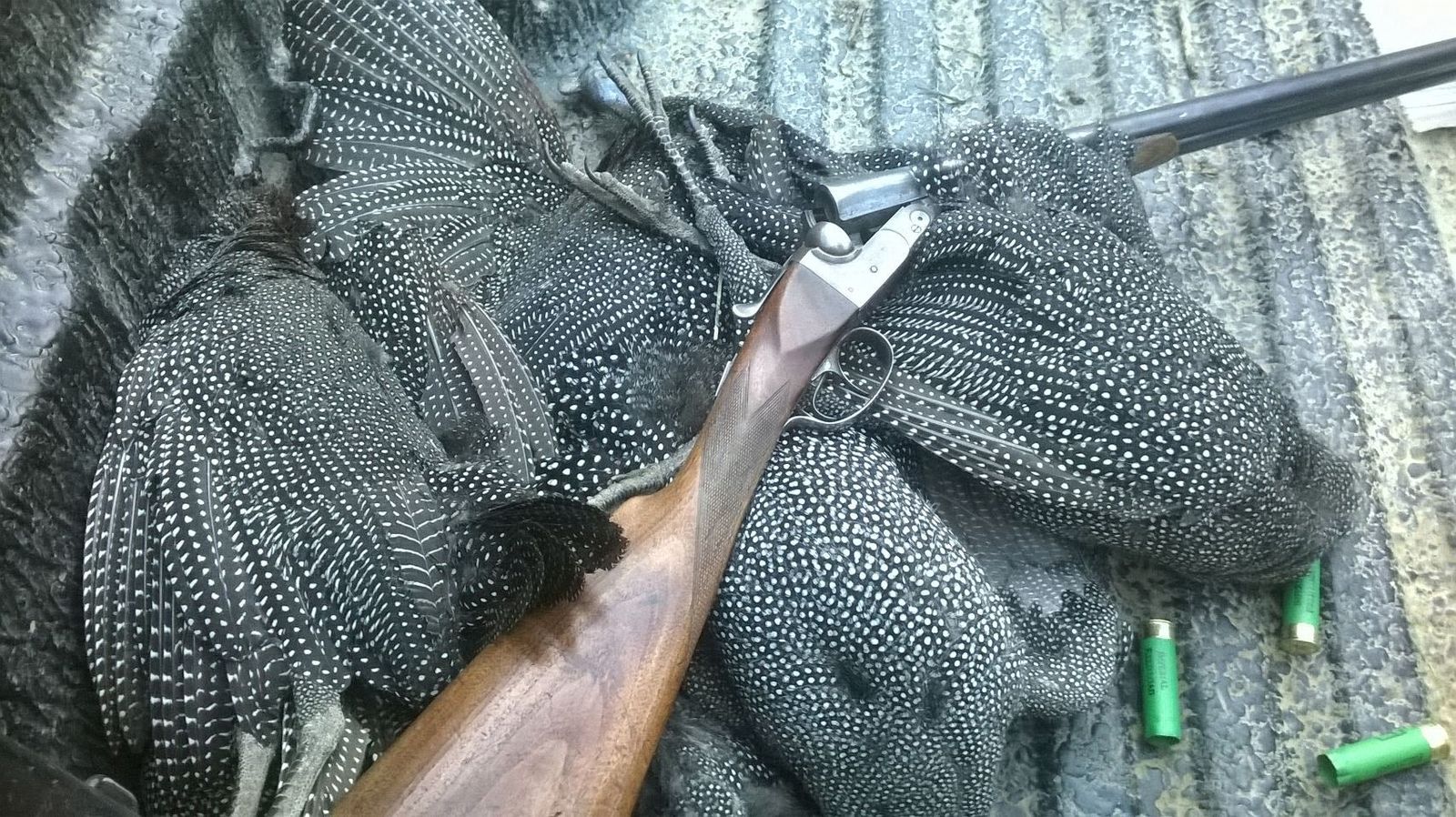
The first flock I tried to shoot beat me on foot. We walked a stubble land at first light with thirty birds ahead of us, and every time we closed the gap they trotted it open again. Not once did they fly. An hour later they were specks against the far fence and we had not fired a shot. That morning taught me the only thing you really need to know about the helmeted guineafowl: it would far rather run than fly, and until you take that choice away from it, you will not get a bird into the air.
Everything else about hunting them follows from that one fact.
Knowing the bird
The helmeted guineafowl is a gregarious, ground-loving gamebird of farmland and grassveld across much of southern Africa. It lives in flocks, roosts in tall trees at night, and comes down at dawn to feed in the open — croplands, stubble, short veld — before watering in the middle of the morning and loafing through the heat of the day. Learn where a flock feeds and where it roosts, and you know where to intercept it.
It is a big, heavy, densely feathered bird, and a tough one. When it does fly it gets up in a clatter, low and fast and usually downwind, and the flock scatters as it goes. Birds are deceptively quick off the mark and carry pellets well, which matters when you come to choose a load. But the running is the thing. A flock will keep three hundred metres of grass between you and them all morning if you let it, and you cannot walk a guineafowl down.
Getting them into the air
The whole art of the sport is turning a running flock into flying birds, and it comes down to taking away the room to run.
Terrain does most of the work. Push a flock toward anything that checks the run — a fence line, a dam wall, a block of standing crop, the lip of a donga or a stretch of broken ground. Birds baulk at a fence and are reluctant to run uphill, so plan your approach to drive them downhill toward the obstacle rather than away from it. When they meet the check with you close behind, they have to fly, and they will come up in a rush.
A flanker or two, walking wide and a little ahead, closes off the escape lane and keeps the flock bunched toward the guns. On a walked-up morning, three or four guns spread across a land, moving steadily and quietly, will pin a flock against a boundary far more often than a single hopeful gun tramping along behind them.
Dogs change everything. A steady flushing dog or a brace of pointers will hold a running flock, put it up in front of you, and — just as importantly — find the birds afterwards. A hit guineafowl is a runner, and a strong-flying bird that pitches into long grass two hundred metres off is lost without a good nose to follow it up. A dog turns a frustrating morning into a shootable one and keeps birds out of the veld to rot. If you shoot guineafowl regularly, a retriever earns its keep.
Two more points of manners, because this is wingshooting. Take them on the wing, not on the ground — a flock ground-sluiced as it runs is neither sport nor a thing to be proud of. And leave the roost alone at first and last light. The pleasure, and the challenge, is in beating the runner fairly and shooting the bird as it flies.
When the flock does lift, it will spray in every direction. Take your bird, then watch where the singles pitch. Scattered birds that drop into cover sit tighter than they ever do as a mob, and a dog can put them up one at a time for the rest of the walk.
The gun for the job
The helmeted guineafowl is a big, tough target often taken at longer range than you would like, because a wild-flushing flock rarely gives you a close shot. That argues for a gun with a bit of reach and a bit of authority, and for most of us that means a 12-bore.
A 20-gauge will do the work on close, well-managed birds over a good dog, and it is a pleasure to carry all day. But the 12 gives you margin — a denser pattern and a heavier charge for the tough bird and the thirty-five-metre shot — and margin is what keeps birds from flying off wounded.
Because the range tends to be moderate to long, lean toward tighter chokes than you would use for francolin over a point. Half and three-quarter, or half and full in a double, put enough pattern out at distance to fold a bird cleanly. Open cylinder is for closer, tighter-sitting birds than these usually are.
A semi-automatic is a sensible choice here. The third shot is genuinely useful when a flock boils up around you, and a gas action softens the recoil of a heavier load over a long day's walking. But a good side-by-side or over-and-under does everything you need. Whatever you carry, let it be a gun you do not mind knocking about — guineafowl country is dusty, thorny and hard on bluing.
Shot and loads
This is where guineafowl differ most from the smaller gamebirds, and where under-gunning does the real damage. A dense-feathered, heavy-bodied bird flying fast needs pellets that carry enough energy to penetrate and enough of them on target to be sure.
For general work, No. 5 shot is the standard guineafowl load and hard to fault. It carries the penetration to reach the vitals of a big bird while still giving you a workable pattern at the ranges these flushes produce. When the birds are flying wide and high, on a windy day, or in a driven set-up where the shots are longer, step up to No. 4. The larger pellet holds its energy further out and drives through the feathering that lets smaller shot glance off.
No. 6 will kill guineafowl close and early, but many good shots find it marginal — birds that would fold to a 5 at the same distance fly on carrying a 6. Save the smaller shot for the francolin.
Load a decent charge behind it. A standard 32-gram game cartridge is the sensible everyday choice, stepping up to 34 or 36 grams for the longer, tougher work. There is no need for the light 28-gram clay loads here; they simply do not put enough shot into a big bird.
Above all, use enough gun and enough shot to kill cleanly. A tough runner hit with too little is a bird that sails off, comes down out of sight and is never found — bad for the bag and worse for the sport. Bring a bird down properly, send the dog, and put it in the bag whole. It is fine eating, well earned, and worth doing right.
Responses
Sign in to respond.
Loading responses…