gottahunt.com/rifles/akliwb9SujSB/the-270-winchester
The .270 Winchester
A figger like Miss America, a disposition like an angel, and that it could bake pies like Mother used to make
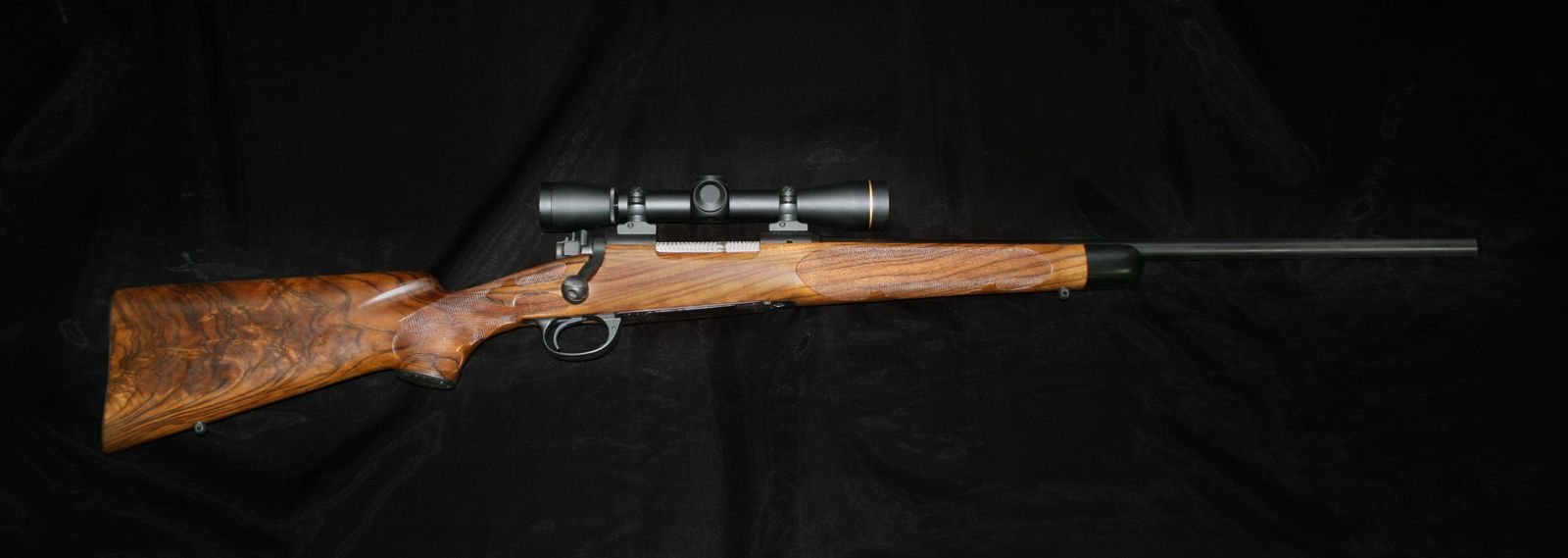 1 / 2
Winchester Repeating Arms Company unveiled their new Model 54 bolt action rifle , along with a new cartridge named the “.270 Winchester Centre Fire” (or .270 WCF), during 1925. This new cartridge was simply a .30-06 Springfield necked down to .277”, and given a slightly longer neck. It offered some astounding ballistics for the day; A 130 grain bullet fired at a muzzle velocity of 3,140 ft/s (later reduced to 3,060 ft/s), intended for long range use on small- to medium-sized North American game in the open plains and mountains of America’s west.
The choice of the .277-inch calibre was an interesting one as at the time no other American or European cartridge had made use of the .277” calibre, and the existing European “7 mm” (actually 7.2 mm or 0.284 inches) calibre was well established world-wide due to the popularity of the 7x57 as a military and hunting cartridge. Yet rather than simply necking the .30-06 case down to .284” diameter, Winchester decided to rather use a bullet of true 7 mm diameter – a difference of a mere 0.007 inches (0.178 mm). Presumably Winchester’s engineers were confident of the ballistic properties of the .284” calibre bullet, but wanted to avoid attaching a European stigma to the new cartridge, which might have prejudiced potential buyers.
Despite its impressive ballistics, the .270 WCF was not an immediate success. At the time, many American deer hunters still preferred their lever action rifles, while most bolt-action riflemen were devoted to the .30-06 Springfield, which was readily available in the form of military surplus M1903 Springfield rifles, with the added benefit of inexpensive ex-military ammunition which could be had for as little as 1c per round for 1918 wartime ammunition. The initial advertised velocity of the 130 grain bullet at 3,140 ft/s was also met with scepticism, and the National Rifle Association secured five .270 Winchester rifles out of stock and had these chronographed with standard 130 grain spitzer factory ammunition. The average velocity for a number of 10-shot strings fired from the various rifles, measured at 150 feet was 3,075 ft/s. These results silenced the sceptics, but the advantages of the .270's flatter trajectory did not mean much to hunters at the time of its introduction, as few could afford riflescopes, and within the limitations of iron sights, the .30-'06 trajectory was more than adequate.
The .270 Winchester’s fortunes began to change for the better from 1936, with the introduction of the Winchester Model 70 rifle, which had a bolt handle and safety designed to facilitate the mounting of a scope. Following WWII, rifle scopes also became more affordable and popular, allowing hunters armed with scoped M70 rifles the opportunity to take advantage of the cartridge’s full potential. Once the benefits of tits flat trajectory could be realised, the cartridge went from strength to strength and became very popular amongst western American hunters.
One of the first hunters to purchase a .270 WCF Winchester Model 54 rifle, in 1925, was American gun writer Jack O'Connor, who was intrigued by the new cartridge’s promising ballistics. He would have been a young man of 23 then, and he soon became smitten with the new cartridge after using it to cleanly kill a number of deer during its first season of use. O’Connor would later become Arms and Ammunition Editor for Outdoor Life, (a position which he held for 31 years, from 1941 to 1972) and one of the most celebrated and respected gun writers in history. He continued to use the .270 Winchester for more than half a century, and the cartridge worked exceptionally well for him. He wrote of his experiences and successes with the .270, attracting the indignation of the big bore school of shooters, led by Elmer Keith, who was known for his outspoken behaviour, and said that the .270 was "useful only as a pest cartridge” and a "damned adequate coyote rifle". O'Connor remained unmoved, and stood by his solid experiences with the cartridge, continuing to use and write about the .270 in favourable terms, though he was often criticized for using the .270 above its capabilities, on larger animals such as Alaskan brown bear, moose, and elk. Not realising that O’Connor was an expert marksman who had many years of hunting experience under his belt, some inexperienced hunters tried to do the same with their .270 rifles, with less stellar results. Many an attack was made against the .270, branding it a meat bruiser, and an unreliable killer, yet for the majority of hunters who had used the cartridge the results spoke for themselves.
Throughout his hunting career, O'Connor probably shot more deer than any other animal, and mountain sheep were the game that he loved to hunt above all others, so it follows that he used the .270 widely for these purposes, never finding it to be wanting. Mostly the elk, moose, and grizzlies which he shot with it were taken as incidental targets during hunts for sheep in remote northern areas. He had no reservations about using it for these larger and heavier animals, and would not shy away from saying so. However, on hunts for specific larger game such as Alaskan brown bear, tiger, and thick-skinned African game, he usually chose much larger and more powerful cartridges, such as the .375 H&H, and .416 Rigby. He was also an avid user and believer in the 7x57 mm and the .30-06 Springfield, and he privately conceded that, with its greater frontal area and heavier bullets, the latter is actually more versatile than the.270.
While it may be true that Jack O’Connor gave the .270 Winchester a head start, the cartridge remains wildly popular today, more than thirty years after his death and 85 years after it introduction. It has built its reputation in the hunting fields and done so without the advantage of cheap surplus ammunition, brass, and rifles. This enduring popularity was confirmed by RCBS die sales for 2009, which revealed that the .270 Winchester ranked number 5 on their list of rifle cartridges, preceded by the .223 Remington, .308 Winchester, .30-06 Springfield and .243 Winchester (in descending order). The .cartridge has enjoyed great popularity here in South Africa too. In their August 2010 newsletter, local ammunition manufacturer PMP published a list of its six best-selling rifle cartridges, based on national ammunition sales over 24 months. The .270 Winchester ranked number four on this list, preceded here by the .30-06 Springfield, .308 Winchester and .243 Winchester (in descending order). This places the .270 as top-seller in its category, which is for long range shooting of small- and medium- sized game, in both South Africa and the United States.
During its eighty-odd years of existence, the .270 has had to face some fairly tough competition in order to retains its status at the top; In 1943 Roy Weatherby developed his first belted magnum, the .270 Weatherby Magnum, based on a blown-out .300 H&H Magnum case shortened to fit standard length bolt actions. The Weatherby Magnum improved on the standard .270 Winchester ballistics by around 300 ft/s, but did so at the cost of much more powder and recoil, and reduced barrel life. While it has enjoyed moderate success, most hunters do not see the value in the .270 Weatherby Magnum, and it has never come close to the .270 Winchester in terms of popularity. During 1957 Remington released the .280 Remington, based on the .30-06 Springfield necked down to accept 7 mm (.284”) bullets, and with the neck moved forward .050” (1.27 mm). Despite having ballistics as good as those of the .270 Winchester (and being more versatile in terms of a wider selection of bullets weights), it had somewhat unspectacular sales and Remington renamed the cartridge in 1979, calling it the 7 mm Express in an attempt to increase sales. This marketing strategy back-fired, with people confusing it with the 7 mm Remington Magnum and they eventually changed the name back to .280 Remington in 1981, barely a year later. This cartridge had the potential to compete directly with the .270 Winchester, and to be at least as good. But the .280 Remington has never been a happy cartridge, and has never realised the potential that it displayed on paper, never coming close to matching the .270 Winchester’s popularity.
In 1962 Remington launched their second bid for a piece of the .270 Winchester’s market share, this time in the form of a belted magnum , the 7mm Remington Magnum, which launched a 150 grain spitzer bullet at a muzzle velocity of 3,110 ft/s, and a 175 grain spitzer bullet at 2,860 ft/s. The 7mm Remington Magnum went on to be a very successful cartridge, and it remains popular to this day, but despite is improved ballistics and a wider range of bullet weights, it too has never managed to dethrone the .270 Winchester.
A recent addition to the Winchester .270 family is the 270 Winchester Short Magnum (WSM), which is based on the short but very fat .300 WSM case necked down to accept standard .277” bullets. It was released in 2002 and almost immediately received much attention, as it filled the need for a short action .270 calibre cartridge. In terms of performance it falls between the.270 Winchester and .270 Weatherby Magnum. The .270 WSM has gained a small but devoted following in the United States, but remains relatively unknown in South Africa.
The load that made the .270 Winchester's reputation was the iconic original 130 grain spitzer bullet, with a muzzle velocity of 3,060 ft/s, which was marketed as being suitable for long range shooting of most big game. (Bear in mind that, in North American terms, "big game" is used to refer to species of indigenous game from the size of deer and larger.) A 100 grain hollow point bullet at 3,540 ft/s was introduced for varmint shooting, but the recoil of the cartridge is too unsympathetic to be a serious varmint cartridge and it has never been a popular choice for this purpose. Later the 150 grain bullet at 2,850 ft/s for larger game such as deer, elk, and moose was a huge success and along with the 130 grain bullet it remains a most popular loading.
Another bullet weight which has gained popularity is the 140 grainer, which optimists see as offering “the best of both worlds,” and cynics see as being “neither here nor there.” Ballistically, it slots in perfectly between the 130 and 150 grain loads, with a muzzle velocity of 2,950 ft/s, so you can decide if you see the glass as being half-full or half–empty. Most ammunition manufactures produce .270 Winchester loads in 130 and 150 grain weights and in various configurations from round nose to boat tailed spitzer. Many now also offer a 140 grain option for this cartridge.
A few bullet makers produce weights heavier than 150 grains in .277” calibre; Nosler make a 160 grain partition spitzer which has a sectional density of 0.298, and has gained a reputation for accuracy and reliable terminal performance, making it a popular choice amongst North American elk hunters. Local bullet manufacturer Claw Bonded makes a 160 and 165 grain spitzer, as well as a 180 grain round nose bullet. Ken Stewart in Polokwane produces a 170 grain Hi-Performer and Woodleigh of Australia produce a180 grain core bonded Protected Point bullet (SD 0.334). These heavier bullets increase the versatility of the cartridge for handloaders, but bear in mind that the .270’s standard barrel twist rate is 1:10 which is more suited to stabilise bullets between 130 and 150 grains. Many (but not all) rifles with this standard twist rate will stabilise the 160 grain bullets, but few will stabilise the heavier 180 grain bullet.
The .270 is not a finicky cartridge to reload, and good accuracy and velocity can usually be achieved using local Somchem powders. Initial suggestions would be to use S365, which seems to the most popular local choice and works well for the lighter 130 and 140 grain bullets. For the heavier 150 grain and 160 grain bullets a slower burning propellant may be desired and through doing some Internet research I found that .270 Winchester reloaders in the USA enjoy excellent results from Hodgdon H4831, which is slower than our S365. Two Somchem powders S361 (ball) andS385 (extruded) have similar burn rates to H4831, and I have found S385 to deliver outstanding results in my Zastava Mauser (which has a 24” barrel) across the various bullet weights from 130 gr to 160 gr. See Table 1 for my loads (important; these loads can only be guaranteed safe in my rifle. Always reduce given loads by 5% to determine start load, and work up towards maximum load in increments of 1 grain.)
Used with the appropriate bullet, the .270 Winchester is suitable for use on a wide range of African game, from small animals such as springbuck and mountain reedbuck, through to medium sized ungulates (mature males weigh in the region of 170 – 190 kg ) such as black wildebeest and red hartebeest. Conventional 130 grain bullets work just fine on small animals such as springbuck, blesbuck, and fallow deer but bullets should be placed behind the shoulder and through the lungs to avoid hitting any heavy bone and to minimise meat damage, which can be considerable at ranges within 200 metres due to the high velocity that this light bullet achieves. For larger animals only premium bullets of 150 grains or (ideally) heavier should be used. This is not a typical bushveld hunting cartridge, but it can be made to do the job either through the use of reduced loads with a faster burning powder such as S335, or by retaining standard velocities and making use of premium bonded (e.g. Rhino, Swift A-Frame, Nosler Accubond) or monometal (e.g. Barnes “X”) bullets. Premium bullets will hold together better at the high velocities that the bullet will maintain at bushveld ranges (usually 100 – 150 metres of less) and will also decrease meat damage as the “hand grenade effect” is reduced. For bushveld use, the .270 will suffice for use on animals from impala size to Nyala bulls, and kudu cows if shot placement is particularly accurate.
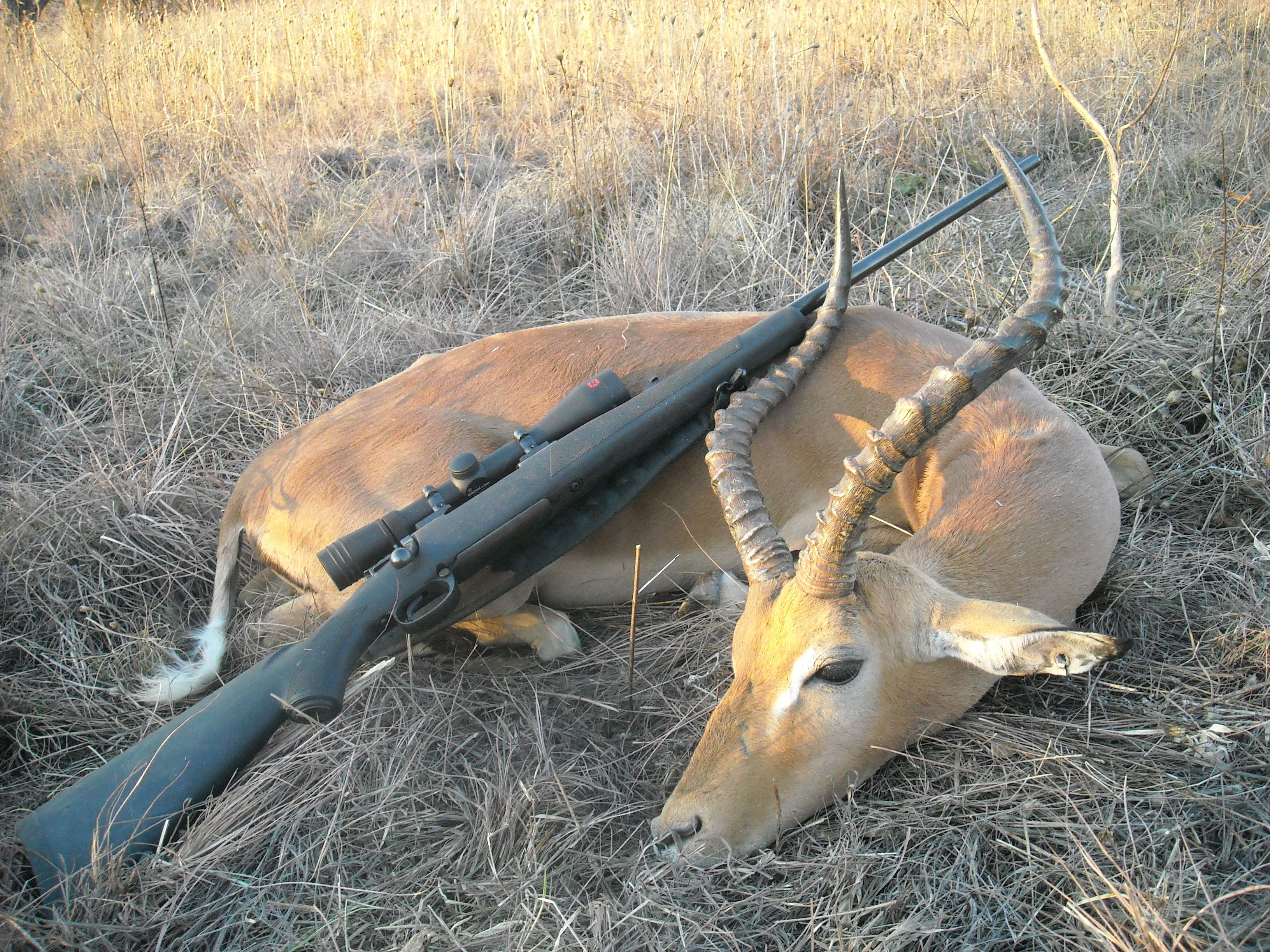
No one could sum up the .270’s success better than the man who admired it most.
Assuming that a cartridge can make its way on merit alone, that cartridge is the .270 WCF. In its early years it sat in the corner, dressed in sackcloth and covered with ashes, while few riflemen suspected that underneath it had a figger like Miss America, a disposition like an angel, and that it could bake pies like Mother used to make.
— Jack O’Connor, December, 1943 issue of Outdoor Life
| Weight | Description | Case | Primer | Powder | Charge | MV | COL (mm) |
|---|---|---|---|---|---|---|---|
| 130 | Hornady InterLock SP | Winchester | CCI 200 | S365 | 54.0 | 3001 | 81.30 |
| 130 | Hornady InterLock SP | Winchester | CCI 250 | S385 | 58.0 | 3027 | 81.60 |
| 140 | Nosler Accubond | Winchester | CCI 200 | S365 | 53.0 | 2949 | 83.70 |
| 150 | Rhino | Winchester | CCI 200 | S385 | 52.0 | 2656 | 79.95 |
| 150 | Hornady InterLock SP | Winchester | PMP LRM | S385 | 56.0 | 2954 | 80.50 |
| 160 | Claw Bonded | Winchester | PMP LRM | S385 | 53.0 | 2693 | 81.50 |
Table 1 Loads fired through 24” barrel
Responses
Sign in to respond.
Loading responses…